


Beyond Code: How Two Armenian Engineers Are Rethinking Software Development
A few years ago, building software required, at a minimum, knowing how to write code. Today, that requirement is disappearing fast. You can simply describe what you want, and AI will attempt to write the code, design the interface, and even put together a first working version of the app. Work that until recently took a team of developers weeks or months can now be done by describing your ideas in plain, conversational language.
Even with all this progress, though, there is a catch. A working app is not the same as a finished product. It has to be deployed to a server, connected to a database, and set up with authentication, monitoring, security, email delivery, and integrations with other services. Then it has to keep running when the user count grows from ten to ten thousand. If the app is the foundation of a real business, all of this stops being nice-to-have and becomes mandatory.
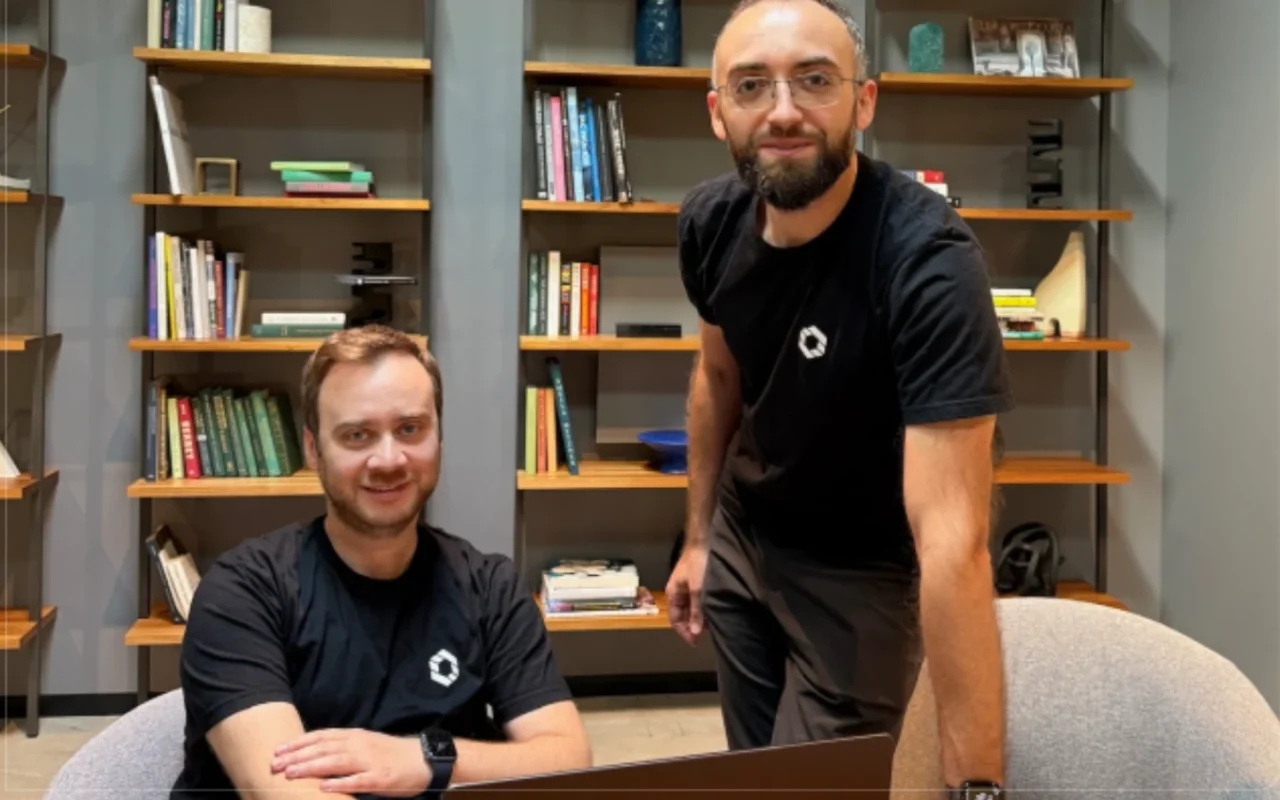
This is the problem Aram Shatakhtsyan and Eduard Piliposyan set out to address when they founded Modelence. As reported by PAN.am.

The platform they built is not yet another AI website generator. They aim to remove the entire technical layer of software development that almost every application requires, but that has little to do with the idea the application is built to serve.
Put simply, Modelence is a platform where technical people, and more importantly, non-technical people, can build fully functional websites, web platforms, and mobile apps without specialized technical knowledge or writing code, just by describing what they want.
It is probably no accident that this idea came from two young people who started out in one of the most technical areas of programming: algorithms, mathematics, and olympiads.
Two Olympiad Competitors
The story of Aram Shatakhtsyan and Eduard Piliposyan begins long before Modelence was even conceived.
Aram was introduced to programming at home. His father had been a software engineer since the 1980s, and Aram grew up surrounded by the computers and code of that era.
“By the time I was five, I was already using my first computer, a laptop with a black-and-white screen where I played games and drew pictures with the mouse. When I was 12, my dad told me it was time to use the computer for more than games. He handed me a notebook and started teaching me my first programming language, C++,” Aram recalls.
The love of programming did not come immediately. In the first few weeks, Aram struggled to remember even the most basic commands needed to write a program that added two numbers. And games were more fun.
“Everything changed when my dad introduced me to visual programming, which let me make games and animations. Before long, I was recreating every game I knew: Tetris, duck hunting, puzzles, and so on. Programming became the thing I was sure would stay with me for the rest of my life.”
Eduard’s path was a little different. He studied at the Shirakatsy Lyceum, then enrolled at the Russian-Armenian (Slavonic) University, and became interested in programming olympiads during his school years.
“Back then, I competed heavily in informatics olympiads and was getting pretty good results in the Armenian national championships. Programming olympiads became my passion because they combined the competitive, almost athletic element with academic knowledge: algebra, geometry, programming, and, to some extent, physics and other fields,” Eduard remembers.
What Aram and Eduard had in common was not just programming but a mathematical way of thinking: algorithms, geometry, graph theory, and the ability to solve difficult problems.
At that point, though, they were not friends. They were rivals.
Eduard competed for the Russian-Armenian University team, while Aram competed for Yerevan State University, and they knew each other mostly through the competitions.
Aram says his own start in olympiads was rough. “Most students that age couldn’t code at all, so both my dad and I were sure I’d do very well. But at my very first olympiad, I failed in the first round and realized how hard the problems actually were. It was a kind of algorithmic programming I’d never seen before. Through my entire first year of competing, I accomplished very little and didn’t even make the top 50.”
That failure was not the end for Aram, who had been taught by his father never to give up. His father bought books on algorithmic programming, and Aram began to prepare seriously. Advice from the national team coach helped too: solve problems posted on online platforms.
“For the next three months, I spent all my free time solving every problem I could find on those platforms, and I finally found what I’d been missing. Soon after, I made the top four in the national selection round, which put me on the four-person team that went to that year’s international olympiad in Mexico. The following year, I took first place in Armenia and won a silver medal at the 2007 international olympiad in Croatia.”
Aram took a simple lesson from this: even a little belief in yourself, combined with the stubbornness to keep going, can take you much further than you first imagined.
During the same period, Eduard was equally immersed in the olympiads. “Our lives in those years revolved around competitions. We entered a lot of contests, traveled to international events, and represented our universities. We also competed in ICPC, the international collegiate programming contest.”
Their paths crossed not while they were rivals, but when they found themselves having to work together.
When Rivals Became a Team
At university, Aram had noticed something odd. The strongest performers in individual competitions did not necessarily make a good team.
“I was on a three-person team where all of us were international olympiad medalists. But we kept losing to teams with far fewer individual accomplishments. We argued constantly and just couldn’t perform as a team, nowhere near as well as we could each do on our own,” Aram recalls with a smile.
In short, the teamwork wasn’t working. Everything changed at one of the open competitions, which allowed new teams to be formed from students at different universities. Aram and Eduard decided to join forces with one more competitor.
And for the first time, they won as a team, taking first place in Armenia by a wide margin over the second-place team.
Eduard says this was the start of his and Aram’s shared path. “We realized we worked really well together, understood each other, and complemented each other. Our knowledge was quite different: in areas where Aram was strong, I might be weaker, and vice versa. That difference is exactly what let us fill in each other’s gaps.”
Aram remembers the same story from the other side. He says that competition was the first time he understood what real teamwork meant. Years later, the experience would repeat itself, not at an olympiad but in business.
When Aram founded CodeSignal, Eduard was the first person he invited to join. It wasn’t only because Eduard was a strong engineer. What mattered more to Aram was that Eduard was one of the people with whom he could build something unique.
Over the years they worked together, building and scaling various production systems, the two friends gradually identified a problem whose solution would later become the foundation of Modelence.
The Problem That Keeps Repeating
When engineers build a new digital product, they usually focus on its functionality. If it’s an online learning platform, you need courses, videos, quizzes, and user accounts. If it’s a car sales site, you need vehicle listings, filters, offers, and a way to get in touch.
Beyond that, you have to set up a database. You have to handle authentication. You have to think about infrastructure. You have to monitor the system. You have to deploy it to production and make sure it can serve a growing number of users.
Most of these problems are the same regardless of what the app actually does. That is what Aram and Eduard had noticed.
Aram explains: “After years of building and running production platforms used by some of the largest tech companies in the world, we noticed that many of the challenges of building production applications are the same no matter what you’re building. You need the same building blocks: a database, authentication, monitoring, infrastructure, and so on.”
Eduard adds: “Working with databases, setting up infrastructure, configuring the system, and keeping it stable have nothing to do with the actual business logic, yet people apply their knowledge over and over to solve the same kinds of problems. Every time someone builds a new product, they have to go through that whole process again to end up with reliable software that runs without breaking. That’s where our idea came from: why not do all of that on everyone’s behalf? Why not build a platform where those problems are already solved automatically?”
A platform like that would let people focus solely on their business logic: figuring out what they need and trying to build it, without worrying about whether the site will go down, whether it will hold up for 100 users, or what happens if there are 10,000 tomorrow.
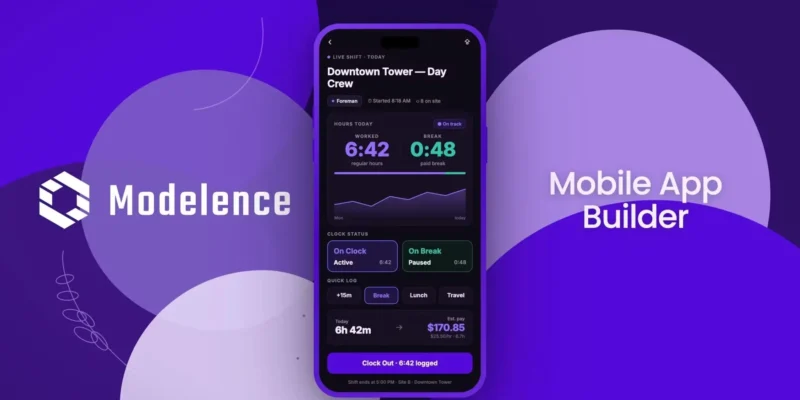
That is how Modelence came about. Products built with it run reliably and scale easily to serve an increasing number of users.
Eduard compares it to a car. Decades ago, a driver often had to be a mechanic as well and know how their car worked. Today, almost anyone can drive without knowing how an internal combustion engine works.
The same applies to business. Someone wants to build a new product, and they no longer need to know all the technical details that used to be required. And if those details can be automated, the question becomes very simple: why start from scratch every time?
“Any business with an idea, or one that wants to automate some process, can make it happen with Modelence. Say you want to build an online car dealership where people can browse your inventory, use filters to find the right option, contact you, submit offers, and so on. A site like that, with all the necessary functionality, is easy to build on our platform,” Eduard notes.
In that case, you no longer have to think about how many cars will be added tomorrow, how much data there will be, or how many users you’ll need to serve. The site might start out serving only Armenia and later expand to, say, China and serve millions of people. Either way, it will keep running and be able to scale.
Building a Site Is Not Enough
Today, AI tools can produce a prototype of a website or app very quickly. You write what you want, and the system tries to build it. The result may even look great. However, a beautiful interface is not yet a product.
Data has to be stored correctly. The system has to withstand the load. You need to know what to do when a service fails. You need visibility into what is happening inside the system.
Say you’ve built an online learning platform where thousands of people can watch videos, take courses, and sit exams at the same time. If the system goes down in the middle of an exam, that’s more than a technical inconvenience: a user could lose their results.
The idea behind Modelence is that this entire infrastructure should not have to be rebuilt from scratch every time. As Aram puts it, Modelence has to be both a framework and a production platform, meaning it helps not only build the app but also keep it running, deploy it to production, and scale it.

“The ability to build an app with AI tools is a convenience, not the core product. Most experienced users eventually abandon traditional app builders in favor of their own tools like Claude Code, Cursor, or Codex, partly because the credits for AI app builders eventually get too expensive to keep paying for, especially when you’re already paying for your own tools.
Modelence is a platform that not only builds, but also helps you keep your sites and apps running in production and scales with you, instead of focusing on impressing you with prototypes in the short term,” Aram adds.
This is the difference between Modelence and AI app builders. The latter are very good for prototypes. You can get a nice-looking site in a few minutes and think, “Wow.” But as the product grows more complex, you may find that you need an engineering team. With Modelence, that need doesn’t arise to begin with.
Even after the site is built, Eduard adds, the most important problems may still remain. For instance, the site will only run on your own computer, in a local environment. If you want to send it to a friend to take a look, you have to deploy it to a server and arrange hosting. Claude Code can give you instructions on how to do that, but it doesn’t actually do it for you.
Then, as the user count grows and the site starts to slow down, you again have to figure out what to do. Then come the questions of deploying and managing the database, and so on.
“Very soon, people will be able to do nearly everything through their personal AI assistant. That’s why we’re integrating into those systems. You can use our website, or open your preferred AI tool, install our plugin there, and just say, ‘Modelence, build me something like this.’ And the system will build it,” Eduard says.
He uses a colorful comparison: using Modelence to build a small site can sometimes feel like using a tank to kill a fly. It’s with large, complex products that the “tank” starts to make sense.
The Old Computer and the New Computer
There is another way to picture the idea behind Modelence.
There used to be two ways to buy a computer. You could buy the processor, graphics card, memory, and other components separately and assemble the machine yourself. That gave you a lot of freedom, but it also required knowledge. Or you could buy a ready-made laptop, where all of that had already been thought through and assembled.
Modelence is trying to be closer to the second option in the world of software. You come in thinking not about how to set up the database or configure the server, but about what exactly you want to build. The rest of the technical side should get in your way as little as possible.
This approach becomes especially interesting as AI spreads, because if AI can write code, the next problem is no longer “Who will write the code?” but how to turn that code into a real, reliable product.
There’s No Need to Write Code Anymore
AI tools are removing the need to write code. For Eduard, this shift is not theoretical; it’s how he works every day.
“A few years ago, I wrote code every day. I’d sit at the computer and build programs in JavaScript, C++, and other languages. Now I write almost no code at all. I use AI, Claude Code, Cursor, and other tools that do that work for me,” Eduard admits.
Instead, he decides what needs to be built, describes it to the AI, and oversees the result. Of course, this doesn’t mean technical knowledge has become useless. Quite the opposite.
“My job now is to understand what I need and to be able to explain very precisely what I want. I have to picture the entire technical system and its architecture at a higher level. AI can build something, but you have to understand what it’s doing. Otherwise, it might pick a tool or technology that won’t serve you later, because the system may not know about your future plans. Either you have to give it very detailed context every time, or you have to oversee the whole process yourself.”
In other words, people are simply changing how they work. Looking back at history, the “classic programmer” has been changing constantly. First, people wrote in machine code, then assembly, then C++, then higher-level languages like JavaScript and Java. That evolution has gone on for decades. Now we’ve reached a stage where code can be produced in ordinary conversational language.
“Now a person can spend less time on every line of code and more time thinking about the overall structure of the system. This is essentially the next chapter in the history of programming.”
Code Is Getting Cheaper, Engineering Is Not
Aram describes the shift in starker terms. In his view, AI has already changed traditional programming beyond recognition, and the job of the “code writer” has disappeared, since AI can already do it better than a human and at a far lower cost.
“But software engineering has always been much more than just writing code. Now that writing code has become so easy, what matters most is being able to design the software and system architecture properly and having good taste in how you build things. As a result, everyone is building more and more software, much faster, which means software that ‘just works’ is worth almost nothing these days. What has real value is software that is well designed and runs reliably,” Aram emphasizes.
Building software that is well designed, reliable, scalable, and doesn’t collapse under its first serious load is Modelence’s core mission.
What Happens to Programmers
One of the most common questions about AI is this: if it can write code, what happens to programmers?
Eduard doesn’t think the answer is mass unemployment, and he points to historical parallels.
“When electricity was invented, people who worked in producing or maintaining gas lamps started losing their old jobs, but in their place, many new professions emerged in the electrical field. The same thing happened when cars replaced coachmen: the coachman’s job vanished, but driving and many other automotive professions appeared,” Eduard points out.
What mostly changes, then, is the qualification required for the work. Of course, if someone has driven a carriage their whole life, switching to a car and picking up new skills all at once is not easy. The same will happen in programming, because this is a completely new way of working. But broadly speaking, AI is changing people’s day-to-day work.
What becomes more important instead is foundational knowledge: mathematics, how databases work, networking, infrastructure, and software architecture. It is knowledge that lets you understand not the syntax of a particular language but what is going on across the whole system.
That is why Eduard advises people learning to program not to focus only on the details of any one programming language.
AI Still Can’t Do Everything
Here, though, Eduard is cautious. He doesn’t believe the rise of AI is a bubble; its capabilities are already far too obvious.
But there is a line, and on the other side of it, many questions remain. Independently making a serious scientific discovery, for example, or finding a new drug, or discovering a cure for an incurable disease. Work in those areas is still ongoing.
And this, according to Eduard, is where it’s important to understand what AI fundamentally is: first and foremost, a tool. A tool that can change how people work.
Why Modelence Was Built Now
This is perhaps one of the most interesting turns in the Modelence story. When the company was being founded, the founders saw the problem mainly through the eyes of developers.
“As developers ourselves, we understood very well how much time and effort goes into the infrastructure any production app requires. But AI changed the game,” Aram notes.
If software used to be built mainly by developers, that number can now multiply, because people who have never been developers are gaining the ability to build software too. In other words, Modelence’s original problem has stayed the same, but the pool of potential users has grown dramatically.
“Someone might have a business idea but no programming skills. They might want to automate part of their work, launch an online service, build an internal tool, or a mobile app. Modelence can help them do that and produce a product that works.”
Armenia as a Network
Another important part of the Modelence story is that both founders are from Armenia. Aram moved to the US at 26 and now lives in the Bay Area. For him, being in Silicon Valley is a major advantage because of the direct access it gives to investors, customers, and partners.
“No video call can replace the connection you can build in person. But drawing on the strength of your own heritage and culture is incredibly important too. Our founding team at Modelence is from Armenia, and we have a strong network of technologists there, which is central to how we operate. In fact, right now we’re putting particular emphasis on marketing and growing our user base through our Armenian network. It’s much easier to create a network effect in a country of 3 million than in one of 300 million,” Aram says.
The Speed That YC Brings
Right after founding the company, they went through the well-known American accelerator Y Combinator. “We did the program in San Francisco, then raised our first seed round of about $3 million and got to work in earnest on the product,” Eduard says.
Aram describes YC not so much as a course as an environment where, in a short span of time, you find yourself alongside founders of other startups who are moving very fast.
The program lasts only a few months, but during that time, you start to reconsider your own assumptions about how much can be done in a short period. The most important lesson, in his words, is exactly that: the limits people set for themselves are often not real limits.
Beyond that, the YC name opens many doors: investors, customers, and partners. In Modelence’s case, that speed suited the field the company operates in particularly well, because AI development doesn’t wait.
“If you compare the tools from a year ago with today’s, the difference can be enormous. A company trying to build a new way of creating software has to evolve at the same pace,” Aram says.
What Aram and Eduard Want to Build
At the end of our conversation, we turn to what the two of them want to build. Aram’s vision is a comprehensive platform where building an advanced application and running it in production no longer requires stitching together several different services, configuring each one separately, and solving the same technical problems all over again every time.
He points to Apple as an example. One of Apple’s advantages, in his words, was that the company created a standardized ecosystem where different components work together without requiring the user to understand all of their internal complexity.
Modelence is trying to bring the same logic to software development: instead of forcing people to understand how all the systems connect to each other, let them focus on the product they actually want to build.
Here, the path of the two former olympiad programmers takes an interesting turn. They began their careers in a world where being a good programmer meant knowing as much as possible about the computer: algorithms, languages, data structures, mathematics, and systems. Years later, they have built a tool that lets others build software without any of that knowledge.
It looks like a contradiction. In fact, it is the very foundation of their idea. When driving became commonplace, drivers were no longer expected to know every part of the engine. When computers became personal, users stopped assembling all the components themselves.
Now the same thing is happening with software. The most important skill for building software is no longer knowing how to write code. What matters more is understanding what you want to build, and then being able to explain it clearly to the machine. Aram and Eduard have found their place in exactly that shift.
Both of them once learned to crack the hardest algorithmic problems. Then, together, they built real production systems. And now they have built a platform through which people who have never competed in a programming olympiad, and may not be programmers at all, will be able to create systems like those.
Aram and Eduard’s first big competition took place years ago. They won back then because they managed to work together. Today, they face a bigger challenge: convincing the world that, in the future, software can be built on the same principle. Only this time, the team isn’t two people. The team is a person and AI.